Deliver board-ready reserve studies to your specifications 5X faster

From mobile field capture to the final report, every component is entered once and carried throughout your study.

Get a demo
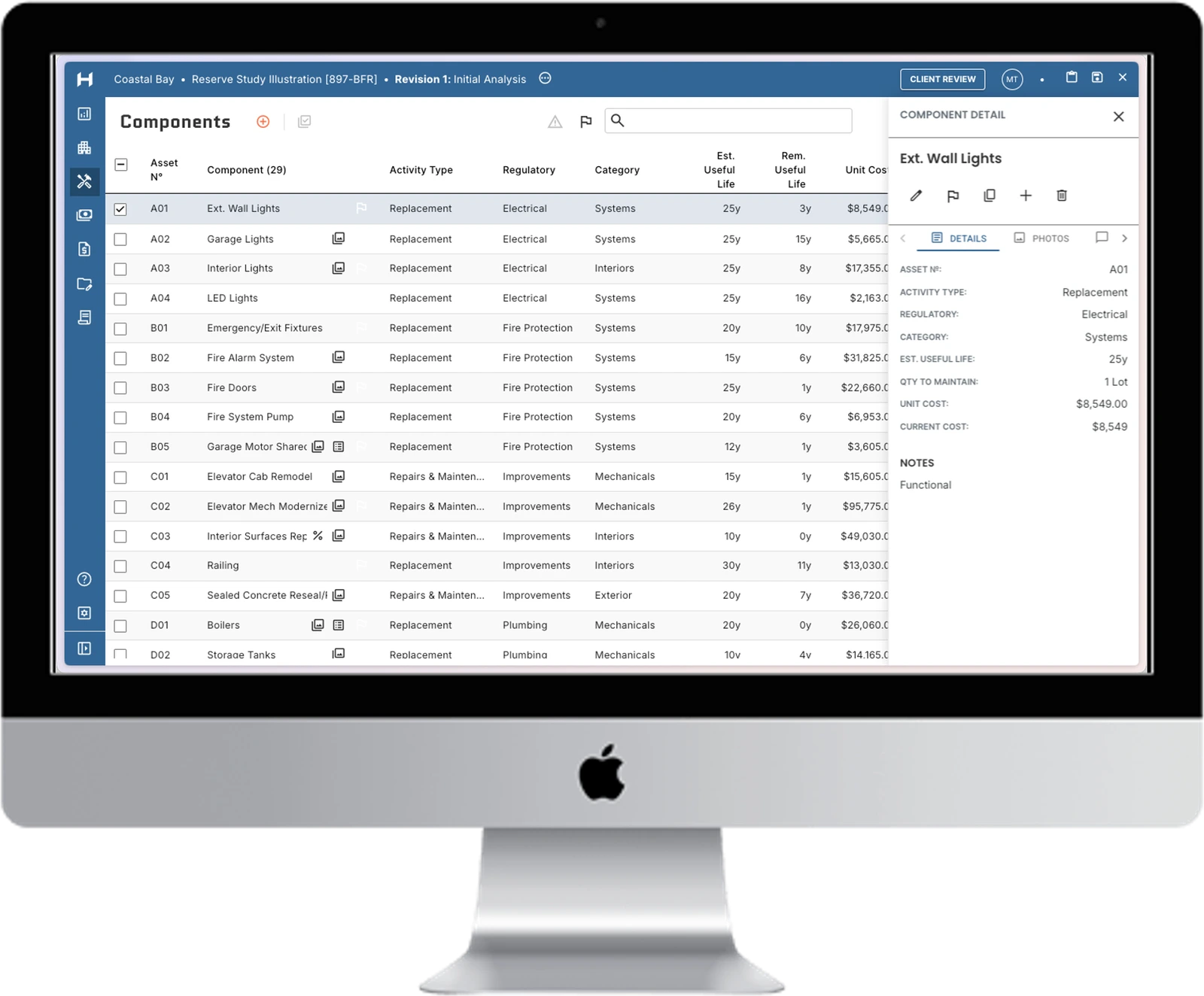
HomeRun IQ component inventory with component details and costs
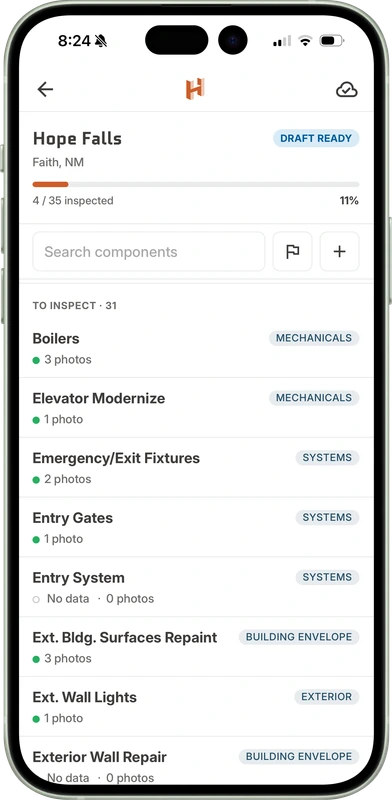
HomeRun IQ mobile field app showing property components and inspection progress

Why reserve studies take longer than they should

Demand for reserve studies keeps growing faster than the number of qualified reserve specialists. Evolving state and regulatory requirements and higher lender reserve minimums mean more studies, held to closer scrutiny. And every board question turns into another round of edits across spreadsheets and documents, a new draft, and another meeting.

How a reserve study comes together in HomeRun IQ

HomeRun IQ is reserve study software built to work the way your firm already does. Your reports look like yours, not a layout a vendor chose for you. And every component, funding plan, and board revision runs from the same data, so you’re not chasing every change across your report.

Before your first study, our team sets up your branded report templates and component library with you, so your studies follow your firm’s standards from day one.

  1. Step 1

    Start your study

    Begin at the office on your desktop, or in the field with the mobile app. Select the study type, enter basic property details, and pull in component lists from your firm’s library, or build an update from the previous one.

  2. Step 2

    Capture components

    Take annotated photos and record observations for each component on site in the mobile app, even in a basement with no signal. Or set up components before the visit and bulk upload photos afterward. It all flows into your study, with no re-entering data.

  3. Step 3

    Develop component plans

    Pull useful life and costs from your firm’s library, set remaining life based on what you found on site, then break the work into actions, phases, and schedules. Pricing stays consistent across your team, no matter who prepares the study.

  4. Step 4

    Create funding plans

    Model any funding strategy, including threshold and component methods, from the association’s starting balance, contributions, and inflation. Compare up to 8 plans side by side, with calculations running in the platform, not in spreadsheets that break.

  5. Step 5

    Generate the report

    Select your firm’s report template, and tables, charts, photos, and narrative language pre-populate from everything you’ve entered. Then you can refine the parts that need your judgment, with no formatting or copy-paste.

  6. Step 6

    Review with managers and board

    Share the study online, or take the board through it live, making changes as they come up. Edit a figure once and every table and chart follows, so you can finalize before the meeting ends.

HomeRun IQ vs. other reserve study tools

Spreadsheets give you full control, but every study costs you hours of manual work. Other reserve study software tries to save you time, but it’s often overly rigid, with report layouts and workflows set by the vendor. HomeRun IQ gives you the control of spreadsheets with the speed of software built for reserve studies.

Scroll horizontally to compare all approaches

HomeRun IQWord & ExcelOther reserve study software
Field photos and notes Captured on site in the mobile app, or bulk uploaded later Photos and notes sorted, captioned, and retyped at your desk Some capture on site with mobile app, but most don’t
Component database Your costs and component details in an editable library Pulled from old, static files, or memory Often a fixed set of component fields that can be hard to customize
Language Library Your firm’s most-used language, ready to drop into any report Cut and paste from prior reports or retyped each time Cut and paste from prior reports or retyped each time
Funding plans Full range of models, including advanced component method, with the ability to compare up to 8 plans side by side Built by hand in spreadsheet formulas Often limited set of funding models
Report format Your existing template replicated, or a new branded design Fully flexible, fully manual Custom layouts only at higher tiers, if available at all
Board revisions Edited live and finalized in the meeting A new draft for every round Some can live edit
Assessment types Reserve studies, SIRS, and PCAs in one platform A separate set of files for each Most are reserve studies only

Reserve study requirements by state, standard, and lender

Reserve study requirements differ from state to state and keep changing, so HomeRun IQ gives you starting points for each requirement that you can adapt to your own methodology.

What standards apply to reserve studies?

In every state, reserve specialists work to industry standards such as CAI’s National Reserve Study Standards and APRA’s standards, which cover the component inventory, condition assessment, and funding analysis. HomeRun IQ is organized around those same building blocks, with component lists, condition and life data, and funding plans that all run from one set of information.

Which states require reserve studies?

As of 2026, twelve states require condominium associations to have reserve studies, also called reserve fund studies, according to CAI, and several have tightened their rules since the Surfside collapse. How often a study is required varies. Below are selected states; see CAI’s summary for the full list:

StateReserve study requirement
CaliforniaVisual inspection at least every 3 years, with annual board review
HawaiiUpdated every 3 years
MarylandEvery 5 years for condominiums
NevadaAt least every 5 years
OregonConducted or reviewed and updated annually
TennesseeEvery 5 years for condominiums
UtahReserve analysis at least every 6 years, updated at least every 3
VirginiaAt least every 5 years
WashingtonUpdated annually, with a site inspection at least every 3 years

Selected states, as of June 2026. See CAI’s summary for the full list.

HomeRun IQ provides state-specific baseline calculations and sample reports as starting points, with templates you can structure to each state’s requirements.

What is a structural integrity reserve study (SIRS)?

A structural integrity reserve study is Florida’s required study of a building’s structural components, due at least every 10 years for condominium and cooperative buildings with three or more habitable stories. Created by SB 4-D after the Surfside collapse and revised by SB 154 in 2023 and HB 913 in 2025, the law also requires association budgets to align with the most recent study, according to Florida’s condominium regulator. Florida separately requires milestone inspections of older buildings, which often happen alongside the SIRS. HomeRun IQ supports SIRS, milestone inspections, and traditional reserve studies, so your firm can deliver all three from the same component data.

What reserve study firms say about HomeRun IQ

"I used to do 2-3 reports a day. Now with HomeRun IQ I can do 10-15."

Reserve study department head

leading Florida provider

"With HomeRun IQ I was able to reduce man hours per study by 20% and this was key to us being able to increase net revenue by 80% in our first year."

Samie Hatim

Professional Engineer, Epic Forensics & Engineering, Inc.

"We’ve been able to address and affect our fee by 30 to 40% because of all of the templating type features that are already baked into HomeRun IQ."

Ryan Jessop

Project Manager, Charles Taylor

See how HomeRun IQ handles your reserve studies

Loading form...